

Archive Record
Images
Metadata
Accession Number |
2004.87.00 |
Catalog Number |
2004.87.01 |
Object Name |
Magazine |
Title |
MERIP Reports No. 34 |
Creator |
Middle East Research & Information Project |
Scope & Content |
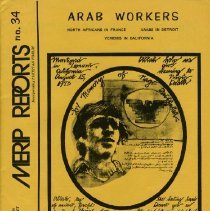
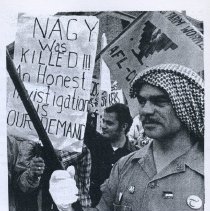
MERIP Reports issue number 34. The cover of this issue memorializes activist Nagi Daifullah, a union interpreter killed by a county sherif in 1973. An ACLU spokesperson said of Daifullah, "He believed that Phillipinos, Chicanos, and Yemenis had enough dignity to stand together." Contents: Maghribin Workers in France by Mahfoud Bennoune Arab Workers in Detroit by Dan Georgakas Organizing an Arab Workers Caucus by Ismael Ahmed Yemeni Farmworkers in California by Mary Bisharat Current Events: Ethiopian Military Consolidates Rule; Egyptian Demonstrations Hit Sadat's Political, Economic Policies Book Review: Islam and Capitalism by Maxime Rodinson Yemeni immigration to the United States has a long history. Yemeni men have been leaving their country for centuries to find work in other parts of the world and support their families back home. By 1890, there were a small number of Yemenis in America, and a handful served in the American military during World War I. After World War II, some came to the U.S. through Vietnam, where they had worked in a variety of trades. It was easier to acquire a U.S. visa from Vietnam than from Yemen. The number of Yemeni immigrants increased rapidly after the abolishment of the quota system in 1965. Many Yemenis have worked on farms in California, in automobile factories in Detroit, and in steel plants in Buffalo, New York. Others have opened small businesses. Earlier Yemeni immigrants were mostly men who intended to work here temporarily and return back home. Since the early 1970s however, many began bringing their families. Today, there are many Yemenis born in the U.S. Nagi Daifullah came to the United States from Yemen looking for a better life. He found employment in the grape fields in California's Central Valley, where many immigrants from Yemen worked. Nagi quickly learned Spanish and English, which enabled him to mediate between workers within the United Farm Workers Union. Soon he became a leader in the fight to improve working conditions. When thousands of grape workers went on strike for fair wages and better working conditions in the summer of 1973, Nagi was among them. During these strikes, local sheriffs arrested more than 3,500 workers and their families, and hundreds were beaten. On August 15, 1973 Nagi Daifullah was beaten to death by a Deputy Sheriff at the age of 24. Today, thousands of farm workers commemorate and honor the Arab American leader, Nagi Daifullah. |
People |
Ahmed, Ismael Daifullah, Nagi |
Search Terms |
Activism Yemeni Americans |
Subjects |
Civil rights Civil rights demonstrations Civil rights leaders Farming Union cases |
Lexicon category |
8: Communication Artifact |
Classification |
Newspapers |